Blog

How to identify high-quality carbon credits: What makes a high-quality carbon credit, and how to evaluate it

Restore through Carbon

Policy & Compliance

Blog

How to identify high-quality carbon credits: What makes a high-quality carbon credit, and how to evaluate it

Restore through Carbon

Policy & Compliance

From Risk to Reward: How UK businesses are building resilience to deliver long-term value
Crista Buznea

Director of Sustainability Marketing

10 min read

From Risk to Reward: How UK businesses are building resilience to deliver long-term value

Many companies navigating the voluntary carbon market (VCM) for the first time are wondering: where do we find high-quality carbon credits that we can actually trust?

The answer is not always straightforward. The VCM includes a wide range of projects, standards, and methodologies, and quality can vary widely between them. At the same time, much more is expected of corporate buyers nowadays. It’s no longer enough to simply buy carbon credits and call it a day; companies must demonstrate how and why they chose the credits they did, and be able to clearly defend why their credits are of a high quality.

With this in mind, understanding what makes a high-quality carbon credit is an essential part of any credible climate strategy.


Why carbon credit quality matters more than ever

Price divergence

One of the clearest signals of a changing market is a changing price. High-quality carbon credits, particularly those with strong verification, robust methodologies, and meaningful co-benefits, are going up in price. At the same time, lower-quality credits remain available at much lower price points.

It’s often true in the VCM that price and quality go hand in hand. Projects that demonstrate strong additionality, permanence, and governance are scarce and therefore in higher demand, and can command a price premium.

For buyers, this creates a more complex landscape. A cheaper ‘price’ is not an indicator of better value (in fact, it’s often the opposite). Understanding what drives quality is essential to making informed purchasing decisions.

Market scrutiny

The VCM is no stranger to scrutiny. In recent years, high-profile investigations have highlighted projects that failed to deliver their claimed impact, sparking a bigger conversation (and broad suspicion) about carbon credit integrity. While these cases do not represent the entire market, they have highlighted major challenges and flaws that do exist in the market, and have changed perceptions about carbon credits.

In this new context, companies are expected to demonstrate strong due diligence on their carbon credit purchases. Stakeholders want to know not just that credits were purchased, but how their quality was assessed and why they can be trusted.

Ratings agencies

Alongside this scrutiny, the market has seen the rapid rise of carbon credit ratings agencies. Organisations such as BeZero Carbon, Sylvera, and Calyx Global provide independent assessments of project quality and risk. These ratings use a wide range of data, such as project design and geospatial analysis, to evaluate carbon credits and projects. For buyers, these are valuable tools. They offer more detailed insights into carbon credit integrity, helping to identify strengths and potential risks across projects.

Legal exposure and reputational risk

Regulators are beginning to take a closer interest in corporate environmental claims, including how businesses buy and talk about carbon credits. In markets like the UK and EU, guidance such as the UK Green Claims Code is setting clearer expectations around transparency and substantiation.

This means companies need to be careful and precise in the way they procure and talk about carbon credits. Claims about net zero or climate impact must be backed by credible, high-quality credits and clear evidence of due diligence.

In this context, understanding what makes a high-quality carbon credit requires not just sustainability expertise, but also an understanding of the implications for compliance and risk management. This is why we’re seeing companies approach carbon credit procurement differently today.

For starters, carbon credit purchasing is no longer owned solely by sustainability teams. Finance teams are getting involved because of the potential cost exposure and long-term liabilities. Legal and corporate risk teams are needed in order to review how claims are substantiated. And communications teams are thinking about how best to talk about climate impact and whether their credits will stand up to public scrutiny.

The decision-making environment for carbon credits is - rightly so - far more complex than it used to be. Carbon credit quality now needs to hold up across multiple perspectives and objectives.

Price divergence

One of the clearest signals of a changing market is a changing price. High-quality carbon credits, particularly those with strong verification, robust methodologies, and meaningful co-benefits, are going up in price. At the same time, lower-quality credits remain available at much lower price points.

It’s often true in the VCM that price and quality go hand in hand. Projects that demonstrate strong additionality, permanence, and governance are scarce and therefore in higher demand, and can command a price premium.

For buyers, this creates a more complex landscape. A cheaper ‘price’ is not an indicator of better value (in fact, it’s often the opposite). Understanding what drives quality is essential to making informed purchasing decisions.

Market scrutiny

The VCM is no stranger to scrutiny. In recent years, high-profile investigations have highlighted projects that failed to deliver their claimed impact, sparking a bigger conversation (and broad suspicion) about carbon credit integrity. While these cases do not represent the entire market, they have highlighted major challenges and flaws that do exist in the market, and have changed perceptions about carbon credits.

In this new context, companies are expected to demonstrate strong due diligence on their carbon credit purchases. Stakeholders want to know not just that credits were purchased, but how their quality was assessed and why they can be trusted.

Ratings agencies

Alongside this scrutiny, the market has seen the rapid rise of carbon credit ratings agencies. Organisations such as BeZero Carbon, Sylvera, and Calyx Global provide independent assessments of project quality and risk. These ratings use a wide range of data, such as project design and geospatial analysis, to evaluate carbon credits and projects. For buyers, these are valuable tools. They offer more detailed insights into carbon credit integrity, helping to identify strengths and potential risks across projects.

Legal exposure and reputational risk

Regulators are beginning to take a closer interest in corporate environmental claims, including how businesses buy and talk about carbon credits. In markets like the UK and EU, guidance such as the UK Green Claims Code is setting clearer expectations around transparency and substantiation.

This means companies need to be careful and precise in the way they procure and talk about carbon credits. Claims about net zero or climate impact must be backed by credible, high-quality credits and clear evidence of due diligence.

In this context, understanding what makes a high-quality carbon credit requires not just sustainability expertise, but also an understanding of the implications for compliance and risk management. This is why we’re seeing companies approach carbon credit procurement differently today.

For starters, carbon credit purchasing is no longer owned solely by sustainability teams. Finance teams are getting involved because of the potential cost exposure and long-term liabilities. Legal and corporate risk teams are needed in order to review how claims are substantiated. And communications teams are thinking about how best to talk about climate impact and whether their credits will stand up to public scrutiny.

The decision-making environment for carbon credits is - rightly so - far more complex than it used to be. Carbon credit quality now needs to hold up across multiple perspectives and objectives.

What defines a high-quality credit

Additionality

Additionality is one of the most fundamental carbon credit quality criteria. A project must demonstrate that its emissions reductions or removals would not have occurred without the revenue generated from carbon credits. If the activity would have happened anyway, the credit does not represent a genuine climate benefit. This is often one of the most challenging aspects to assess, and one of the main areas where methodologies and project-level factors matter.

Permanence

Permanence refers to how long the carbon benefit lasts. For some project types, particularly nature-based solutions, carbon storage can be reversed through events such as fires, disease, or land-use change. High-quality projects identify these risks and implement mechanisms to manage them over time. For buyers, permanence is closely related to long-term climate impact. Short-lived benefits may not align with net-zero goals (or sit very well with the stakeholders who care about your climate impact).

Leakage

Leakage occurs when a project reduces emissions in one area but causes an increase elsewhere. For example, protecting one forest might simply move deforestation activity to another region. This can happen at the local or project level, but also at the market level: if projects reduce the supply of a commodity like timber or agricultural land, this can send prices up, making the same activity more economically attractive in new regions. High-quality projects are designed and monitored in ways that reduce this risk. Without this, the net climate benefit of a project may be overstated.

Governance

Strong governance underpins carbon credit integrity. At a minimum, projects need transparent documentation, robust monitoring systems, and independent validation and verification. They also need clear accountability structures and stakeholder engagement. Projects that operate within well-governed carbon credit standards, and are supported by credible verification processes, give buyers more confidence.

ICVCM Core Carbon Principles

The ICVCM Core Carbon Principles (CCPs) are one of the most important reference points for high-quality carbon credits.

Developed by the Integrity Council for the Voluntary Carbon Market (ICVCM), the CCPs set out a clear, structured definition of what carbon credit integrity looks like in practice. They are designed to create consistency across the voluntary carbon market and give buyers greater confidence in what they are purchasing.

At a high level, the CCPs cover three core areas:

1. Strong governance and transparency
Carbon credit programmes must demonstrate clear governance structures, independent oversight, and transparent data. This includes publicly available documentation, clear registries, and tracking systems that prevent double counting.

2. Credible emissions impact
Projects must deliver real, measurable, and long-lasting emissions reductions or removals. This requires strong additionality, robust quantification methodologies, and clear approaches to managing permanence risk.

3. Sustainable development and safeguards
Projects must deliver positive outcomes beyond carbon, while avoiding harm to local communities and ecosystems. They should align with sustainable development goals and safeguards around social and environmental impacts.

To operationalise this, the ICVCM uses a two-level assessment approach:

  • Programme-level assessment (carbon standards must meet CCP eligibility requirements)

  • Methodology-level assessment (individual methodologies must meet CCP approval criteria)

For buyers, CCP alignment is a useful signal of quality, particularly as more methodologies are assessed and approved. However, it is not a shortcut.

Even a CCP-aligned methodology can produce variable results depending on how it is implemented at the project level. This is why leading approaches to carbon credit procurement treat the CCPs as a foundation (and you should too).

In practice, the most robust strategies use the ICVCM Core Carbon Principles alongside deeper project-level analysis to build a more complete picture of carbon credit integrity.

Additionality

Additionality is one of the most fundamental carbon credit quality criteria. A project must demonstrate that its emissions reductions or removals would not have occurred without the revenue generated from carbon credits. If the activity would have happened anyway, the credit does not represent a genuine climate benefit. This is often one of the most challenging aspects to assess, and one of the main areas where methodologies and project-level factors matter.

Permanence

Permanence refers to how long the carbon benefit lasts. For some project types, particularly nature-based solutions, carbon storage can be reversed through events such as fires, disease, or land-use change. High-quality projects identify these risks and implement mechanisms to manage them over time. For buyers, permanence is closely related to long-term climate impact. Short-lived benefits may not align with net-zero goals (or sit very well with the stakeholders who care about your climate impact).

Leakage

Leakage occurs when a project reduces emissions in one area but causes an increase elsewhere. For example, protecting one forest might simply move deforestation activity to another region. This can happen at the local or project level, but also at the market level: if projects reduce the supply of a commodity like timber or agricultural land, this can send prices up, making the same activity more economically attractive in new regions. High-quality projects are designed and monitored in ways that reduce this risk. Without this, the net climate benefit of a project may be overstated.

Governance

Strong governance underpins carbon credit integrity. At a minimum, projects need transparent documentation, robust monitoring systems, and independent validation and verification. They also need clear accountability structures and stakeholder engagement. Projects that operate within well-governed carbon credit standards, and are supported by credible verification processes, give buyers more confidence.

ICVCM Core Carbon Principles

The ICVCM Core Carbon Principles (CCPs) are one of the most important reference points for high-quality carbon credits.

Developed by the Integrity Council for the Voluntary Carbon Market (ICVCM), the CCPs set out a clear, structured definition of what carbon credit integrity looks like in practice. They are designed to create consistency across the voluntary carbon market and give buyers greater confidence in what they are purchasing.

At a high level, the CCPs cover three core areas:

1. Strong governance and transparency
Carbon credit programmes must demonstrate clear governance structures, independent oversight, and transparent data. This includes publicly available documentation, clear registries, and tracking systems that prevent double counting.

2. Credible emissions impact
Projects must deliver real, measurable, and long-lasting emissions reductions or removals. This requires strong additionality, robust quantification methodologies, and clear approaches to managing permanence risk.

3. Sustainable development and safeguards
Projects must deliver positive outcomes beyond carbon, while avoiding harm to local communities and ecosystems. They should align with sustainable development goals and safeguards around social and environmental impacts.

To operationalise this, the ICVCM uses a two-level assessment approach:

  • Programme-level assessment (carbon standards must meet CCP eligibility requirements)

  • Methodology-level assessment (individual methodologies must meet CCP approval criteria)

For buyers, CCP alignment is a useful signal of quality, particularly as more methodologies are assessed and approved. However, it is not a shortcut.

Even a CCP-aligned methodology can produce variable results depending on how it is implemented at the project level. This is why leading approaches to carbon credit procurement treat the CCPs as a foundation (and you should too).

In practice, the most robust strategies use the ICVCM Core Carbon Principles alongside deeper project-level analysis to build a more complete picture of carbon credit integrity.

How to assess project integrity

Standard vs methodology vs project

Assessing carbon credit integrity requires looking beyond a single label or certification. There are three key layers:

  • Standard: The organisation issuing the credits and setting overarching rules. (The ICVCM calls this ‘Programmes’.)

  • Methodology: The framework used to calculate emissions reductions or removals

  • Project: The real-world implementation and outcomes on the ground

Each layer plays a role, but none is sufficient on its own.

A strong carbon standard does not guarantee that every project under it is high quality. Similarly, a robust methodology can still be applied inconsistently. This is why project-level assessment is critical.

Ecologi’s Carbon Project Assessment Framework reflects this layered approach, combining standard-, methodology-, and project-level analysis to build a more complete picture of quality and risk.

Ratings consensus

Rather than relying on a single rating from a single provider, a more robust approach is to look for consensus across multiple assessments. When different methodologies point to similar conclusions about a project, buyers can be more confident in the project’s quality.

Risk-adjusted logic

A key part of assessing high-quality carbon credits is understanding risk. A project may show strong potential impact, but still carry risks related to delivery, permanence, or governance. These risks need to be factored into any assessment.

Ecologi’s framework, for example, applies a risk-adjusted scoring model across climate, nature, and people outcomes, reflecting both the quality of a project and the likelihood that its benefits will be delivered. This kind of risk-adjusted logic is critical. It moves buyers beyond theoretical impact and allows them to assess real-world performance.

Comparison and context

Another important consideration is how different types of projects compare.

Nature-based projects, for example, often offer strong co-benefits around biodiversity and community engagement, but may not be as durable. Engineered carbon removal projects can provide more durable storage, but are typically more expensive and are still in their early days. Avoidance projects can deliver impact in the short term, but many avoidance methodologies face greater scrutiny around additionality.

This means it is not always easy to say one type of project is inherently better than another. Instead, it highlights the importance of thinking at the portfolio level. High-quality carbon credit strategies often combine different project types in an attempt to balance risk, cost, and climate impact over time, and to align with best practice, as set out by the Oxford Principles.

Another element to consider is context. A project that performs strongly in one geography or policy environment may not perform the same way elsewhere. Local governance, regulatory stability, and environmental conditions all influence outcomes, so a mix of projects from different geographies may be an appropriate way to structure your portfolio.

Ultimately, buyers need to understand that assessing carbon credit integrity is not just about applying a fixed checklist. It requires informed judgment, a consistent set of criteria that you apply across all projects you screen, and an understanding of how your choices will stack up at the portfolio level.

Standard vs methodology vs project

Assessing carbon credit integrity requires looking beyond a single label or certification. There are three key layers:

  • Standard: The organisation issuing the credits and setting overarching rules. (The ICVCM calls this ‘Programmes’.)

  • Methodology: The framework used to calculate emissions reductions or removals

  • Project: The real-world implementation and outcomes on the ground

Each layer plays a role, but none is sufficient on its own.

A strong carbon standard does not guarantee that every project under it is high quality. Similarly, a robust methodology can still be applied inconsistently. This is why project-level assessment is critical.

Ecologi’s Carbon Project Assessment Framework reflects this layered approach, combining standard-, methodology-, and project-level analysis to build a more complete picture of quality and risk.

Ratings consensus

Rather than relying on a single rating from a single provider, a more robust approach is to look for consensus across multiple assessments. When different methodologies point to similar conclusions about a project, buyers can be more confident in the project’s quality.

Risk-adjusted logic

A key part of assessing high-quality carbon credits is understanding risk. A project may show strong potential impact, but still carry risks related to delivery, permanence, or governance. These risks need to be factored into any assessment.

Ecologi’s framework, for example, applies a risk-adjusted scoring model across climate, nature, and people outcomes, reflecting both the quality of a project and the likelihood that its benefits will be delivered. This kind of risk-adjusted logic is critical. It moves buyers beyond theoretical impact and allows them to assess real-world performance.

Comparison and context

Another important consideration is how different types of projects compare.

Nature-based projects, for example, often offer strong co-benefits around biodiversity and community engagement, but may not be as durable. Engineered carbon removal projects can provide more durable storage, but are typically more expensive and are still in their early days. Avoidance projects can deliver impact in the short term, but many avoidance methodologies face greater scrutiny around additionality.

This means it is not always easy to say one type of project is inherently better than another. Instead, it highlights the importance of thinking at the portfolio level. High-quality carbon credit strategies often combine different project types in an attempt to balance risk, cost, and climate impact over time, and to align with best practice, as set out by the Oxford Principles.

Another element to consider is context. A project that performs strongly in one geography or policy environment may not perform the same way elsewhere. Local governance, regulatory stability, and environmental conditions all influence outcomes, so a mix of projects from different geographies may be an appropriate way to structure your portfolio.

Ultimately, buyers need to understand that assessing carbon credit integrity is not just about applying a fixed checklist. It requires informed judgment, a consistent set of criteria that you apply across all projects you screen, and an understanding of how your choices will stack up at the portfolio level.

Risks of low-quality credits

Climate underperformance

Most importantly, low-quality credits fail to deliver meaningful emissions reductions or removals. This limits the effectiveness of carbon credit programmes and undermines the broader goal of the VCM, which is to drive meaningful climate action. For businesses serious about climate action, investing in high-quality carbon credits is the only way to ensure that your efforts contribute to genuine, measurable outcomes.

Reputational damage

Using low-quality carbon credits can undermine your company’s climate claims. As scrutiny from stakeholders increases, businesses that cannot demonstrate robust due diligence may face accusations of greenwashing. This can erode trust with customers, investors, and employees. Reputational risk is, ultimately, financial risk, as eroded trust eventually results in lost customer bases and investment.

Return on investment

Low-quality credits may not deliver the outcomes they promise, which means the money you spend on climate action may not, in fact, translate into real impact. In some cases, businesses may need to replace these credits in the future, driving up costs overall. And if word gets out, the reputational damage is also expensive – PR agencies, legal counsel, and diverting your internal teams to deal with the fallout comes with a price tag.

Climate underperformance

Most importantly, low-quality credits fail to deliver meaningful emissions reductions or removals. This limits the effectiveness of carbon credit programmes and undermines the broader goal of the VCM, which is to drive meaningful climate action. For businesses serious about climate action, investing in high-quality carbon credits is the only way to ensure that your efforts contribute to genuine, measurable outcomes.

Reputational damage

Using low-quality carbon credits can undermine your company’s climate claims. As scrutiny from stakeholders increases, businesses that cannot demonstrate robust due diligence may face accusations of greenwashing. This can erode trust with customers, investors, and employees. Reputational risk is, ultimately, financial risk, as eroded trust eventually results in lost customer bases and investment.

Return on investment

Low-quality credits may not deliver the outcomes they promise, which means the money you spend on climate action may not, in fact, translate into real impact. In some cases, businesses may need to replace these credits in the future, driving up costs overall. And if word gets out, the reputational damage is also expensive – PR agencies, legal counsel, and diverting your internal teams to deal with the fallout comes with a price tag.

What this means for your strategy next

Understanding what makes a high-quality carbon credit is only the first step. The real challenge is applying that understanding consistently across your strategy.

In practice, this means moving away from one-off purchasing decisions and toward a more structured, risk-aware approach to carbon credit procurement.

Treat quality as a baseline

Carbon credit quality should be seen as a baseline - as a non-negotiable in your purchasing requirements, not a trade-off. Cheaper credits may appear attractive in the short term, but they introduce more risk than they are worth. Buying high-quality carbon credits helps ensure that your investment translates into real climate impact and stands up to external scrutiny.

Evolve your approach over time

As your climate strategy matures, so too should your approach to sourcing and evaluating credits. This may include incorporating ratings data, diversifying across project types, and planning ahead for future needs such as carbon removals.

Align your teams

Sustainability, finance, procurement, and communications all have a stake in how carbon credits are selected and used. A clear, shared understanding of quality criteria helps ensure decisions are consistent, defensible, and aligned with broader business objectives.

As expectations and requirements for operating in the VCM become stricter and more complicated, your procurement approach should become more sophisticated. Companies that take a structured, informed approach to carbon credit quality will be better positioned to manage risk, build credibility, and contribute to meaningful climate outcomes.

Understanding what makes a high-quality carbon credit is only the first step. The real challenge is applying that understanding consistently across your strategy.

In practice, this means moving away from one-off purchasing decisions and toward a more structured, risk-aware approach to carbon credit procurement.

Treat quality as a baseline

Carbon credit quality should be seen as a baseline - as a non-negotiable in your purchasing requirements, not a trade-off. Cheaper credits may appear attractive in the short term, but they introduce more risk than they are worth. Buying high-quality carbon credits helps ensure that your investment translates into real climate impact and stands up to external scrutiny.

Evolve your approach over time

As your climate strategy matures, so too should your approach to sourcing and evaluating credits. This may include incorporating ratings data, diversifying across project types, and planning ahead for future needs such as carbon removals.

Align your teams

Sustainability, finance, procurement, and communications all have a stake in how carbon credits are selected and used. A clear, shared understanding of quality criteria helps ensure decisions are consistent, defensible, and aligned with broader business objectives.

As expectations and requirements for operating in the VCM become stricter and more complicated, your procurement approach should become more sophisticated. Companies that take a structured, informed approach to carbon credit quality will be better positioned to manage risk, build credibility, and contribute to meaningful climate outcomes.

How Ecologi conducts due diligence on carbon projects

Identifying high-quality carbon credits requires understanding evolving standards, assessing project-level performance, and making decisions in a market where quality and risk can vary significantly.

That’s why many businesses choose to work with partners like Ecologi.

We help companies conduct due diligence and select projects, build diversified portfolios aligned with best practice, and more. Our general due diligence principles are applied universally across the voluntary carbon market to support our efforts to supply only high-quality carbon credits.

What’s different about our due diligence
  • ICROA-endorsed standards only – we supply credits exclusively from carbon standards which are ICROA-endorsed.

  • Responsive to ICVCM decisions – we support the ICVCM’s two-tick approach to providing CCP-Approval to project methodologies, and we go further still, to assess individual projects on their merits and limitations as well.

  • Keep the carbon credit life cycle as short as possible – 75% of our credits in 2024 came directly from project developers and their nominated dispensaries (as opposed to intermediaries on the secondary market), maximising the proportion of purchase price which goes to the developer.

  • Locally-appropriate projects only – we take care to ensure that supported projects are being applied in appropriate geographies, where they can have the greatest impact.

  • Deep project-level scrutiny – our extensive assessment criteria are specific to each type of project, and we assess every project against these criteria, ensuring the project’s specifics have been taken into account.

  • Methodological consensus – we synthesise data we receive from our partners Sylvera, BeZero Carbon, Calyx Global and Renoster) with our own in-house analysis to uncover where there is consensus about project quality, and improve confidence.

Our Carbon Project Assessment Framework (CPAF)

Ecologi’s rigorous, science-led Carbon Project Assessment Framework (CPAF) to help businesses navigate carbon credit procurement with confidence.  The framework considers a wide range of quality and risk factors, grouped into three pillars of impact:

  • Climate – Does the project deliver measurable carbon reductions or removals?

  • Nature – Does it support biodiversity, ecosystems or land restoration?

  • People – Does it respect communities and human rights?

For each pillar, projects gain points for quality and lose points for risk. These are combined into a risk-adjusted score out of 100.

To qualify for inclusion in an Ecologi portfolio, projects must:

  • Achieve a minimum overall score of 80, and

  • Score at least 65 in each of the three impact pillars

This ensures every project we support delivers not just on carbon, but on broader environmental and social outcomes.
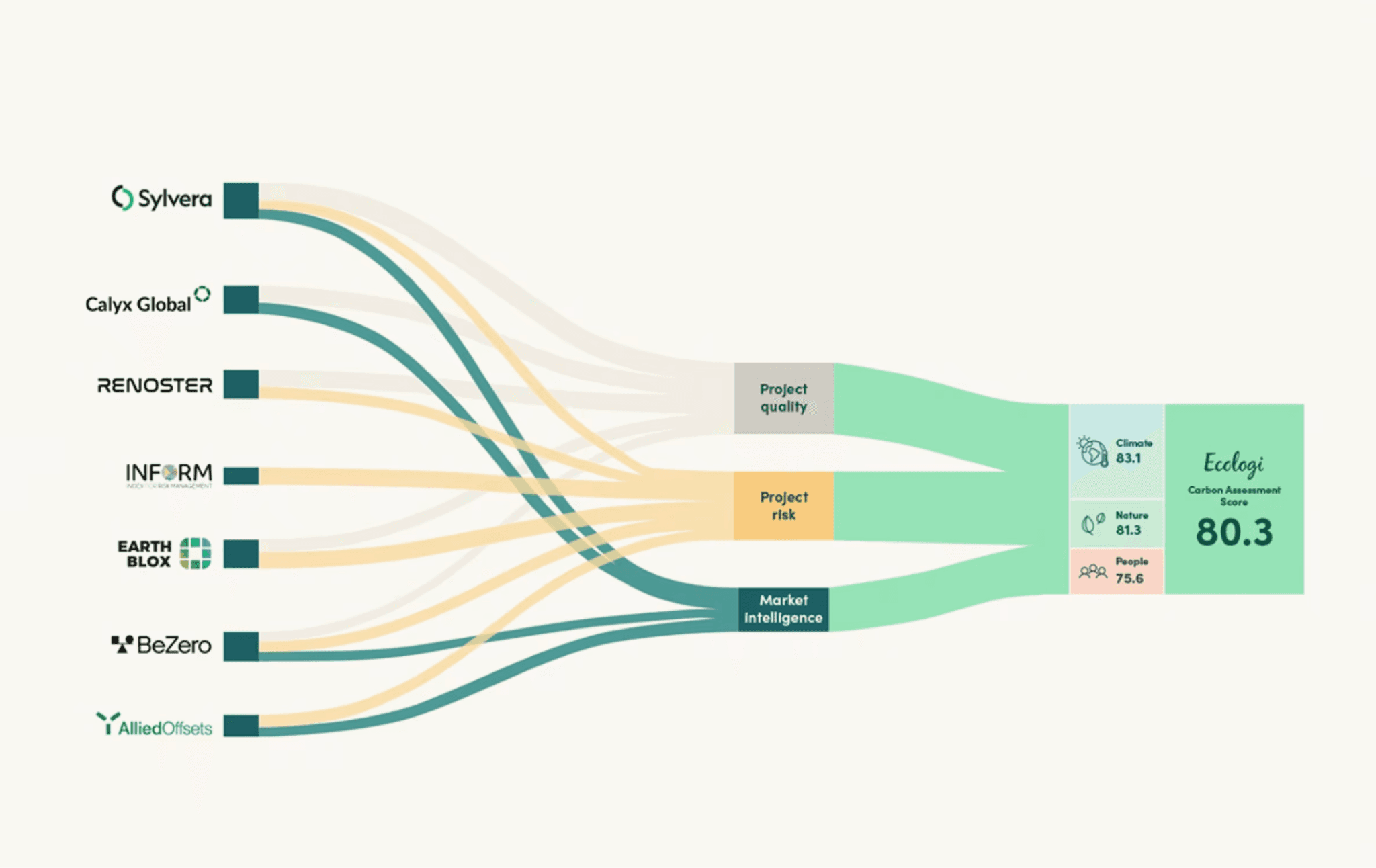
What goes into the score?

We draw on data from independent ratings agencies like Sylvera, BeZero Carbon, Calyx Global, and Renoster. We also analyse:

  • The credit’s life cycle and market traceability

  • The project developer’s track record

  • Localised risk data (e.g. INFORM Index)

  • Long-term monitoring tools like GIS and satellite verification

This allows us to go beyond claims on a registry and evaluate real performance on the ground.

We also prioritise credits that:

It’s a rigorous process, and that’s exactly what high-integrity climate action demands.

Looking for carbon credit expertise?

If your organisation is looking to build a carbon credit strategy grounded in integrity, transparency, and long-term value, speak to one of our climate experts to get started.

Identifying high-quality carbon credits requires understanding evolving standards, assessing project-level performance, and making decisions in a market where quality and risk can vary significantly.

That’s why many businesses choose to work with partners like Ecologi.

We help companies conduct due diligence and select projects, build diversified portfolios aligned with best practice, and more. Our general due diligence principles are applied universally across the voluntary carbon market to support our efforts to supply only high-quality carbon credits.

What’s different about our due diligence
  • ICROA-endorsed standards only – we supply credits exclusively from carbon standards which are ICROA-endorsed.

  • Responsive to ICVCM decisions – we support the ICVCM’s two-tick approach to providing CCP-Approval to project methodologies, and we go further still, to assess individual projects on their merits and limitations as well.

  • Keep the carbon credit life cycle as short as possible – 75% of our credits in 2024 came directly from project developers and their nominated dispensaries (as opposed to intermediaries on the secondary market), maximising the proportion of purchase price which goes to the developer.

  • Locally-appropriate projects only – we take care to ensure that supported projects are being applied in appropriate geographies, where they can have the greatest impact.

  • Deep project-level scrutiny – our extensive assessment criteria are specific to each type of project, and we assess every project against these criteria, ensuring the project’s specifics have been taken into account.

  • Methodological consensus – we synthesise data we receive from our partners Sylvera, BeZero Carbon, Calyx Global and Renoster) with our own in-house analysis to uncover where there is consensus about project quality, and improve confidence.

Our Carbon Project Assessment Framework (CPAF)

Ecologi’s rigorous, science-led Carbon Project Assessment Framework (CPAF) to help businesses navigate carbon credit procurement with confidence.  The framework considers a wide range of quality and risk factors, grouped into three pillars of impact:

  • Climate – Does the project deliver measurable carbon reductions or removals?

  • Nature – Does it support biodiversity, ecosystems or land restoration?

  • People – Does it respect communities and human rights?

For each pillar, projects gain points for quality and lose points for risk. These are combined into a risk-adjusted score out of 100.

To qualify for inclusion in an Ecologi portfolio, projects must:

  • Achieve a minimum overall score of 80, and

  • Score at least 65 in each of the three impact pillars

This ensures every project we support delivers not just on carbon, but on broader environmental and social outcomes.

What goes into the score?

We draw on data from independent ratings agencies like Sylvera, BeZero Carbon, Calyx Global, and Renoster. We also analyse:

  • The credit’s life cycle and market traceability

  • The project developer’s track record

  • Localised risk data (e.g. INFORM Index)

  • Long-term monitoring tools like GIS and satellite verification

This allows us to go beyond claims on a registry and evaluate real performance on the ground.

We also prioritise credits that:

It’s a rigorous process, and that’s exactly what high-integrity climate action demands.

Looking for carbon credit expertise?

If your organisation is looking to build a carbon credit strategy grounded in integrity, transparency, and long-term value, speak to one of our climate experts to get started.

Related articles

Is your business ready
to take climate action?

If this article has inspired your business to start its climate journey, talk to our team today.

Is your business ready
to take climate action?

If this article has inspired your business to start its climate journey, talk to our team today.

Is your business ready
to take climate action?

If this article has inspired your business to start its climate journey, talk to our team today.